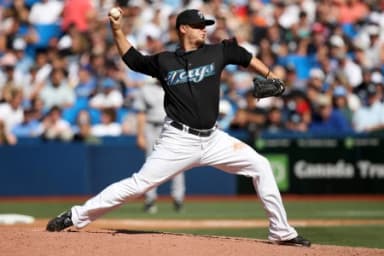

Dylan Cease's fastball has dipped under 95 mph in back-to-back starts for the first time in his career.
That's part of a velocity trend that's been building for much of the season, not a sudden collapse in his last two outings.
Cease has thrown 1,036 four-seamers this season alone, compared to just 347 sinkers across his entire eight-year career, making the four-seamer the pitch that truly defines his outcomes.
His average four-seam velocity has sat at 97 mph or higher in 17 of his 28 starts this year, though he hasn't hit that mark since July 8.
Splitting his season roughly around the All-Star break shows something interesting. His results before and after track closely, even as his velocity has trended down.
Strikeouts have come down some, and his career track record in the sub-95 range isn't encouraging. But he's shown real success living in the 95-96.9 range for much of the summer, even though his career numbers there are only middling.
Why his changeup may be saving this stretch
Part of the explanation may be his evolving repertoire as a Blue Jay, particularly a changeup that's emerged as a genuine swing-and-miss weapon.
If the slider and changeup are both nasty enough on their own, getting by on mid-90s heat becomes far more sustainable than it would be for a one-pitch fastball reliant arm.
Looking at his career on a per-pitch basis, whiffs are heavily tied to elite velocity. Fastballs below 95 haven't necessarily gotten hammered, but they also aren't missing many bats.
His 2026 numbers muddy that picture slightly, showing his four-seamer success has been less dependent on velocity than in past seasons, even as the same basic pattern holds: he's typically been at his best in the 97-98.9 range across larger samples.
That's the real tension here. Intuitively, a starter should perform best throwing hardest, and most of the evidence backs that up for Cease.
His last two outings are legitimately concerning given how much Toronto needs him down the stretch. There isn't much history to suggest he can consistently succeed with the fastball he's currently showing.
But there's real reason for optimism too. Cease has shown he's less reliant on raw velocity than at other points in his career, missing bats with secondary stuff even as the fastball has softened.
Previous versions of this pitcher might not have survived a late-season velocity dip like this one. This version looks better equipped to manage it than ever before.
Are you worried about Dylan Cease's fading velocity heading into the final stretch?