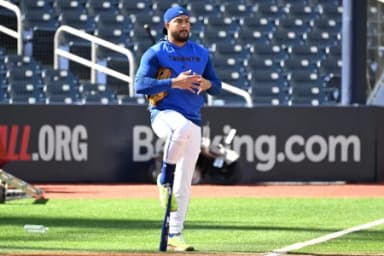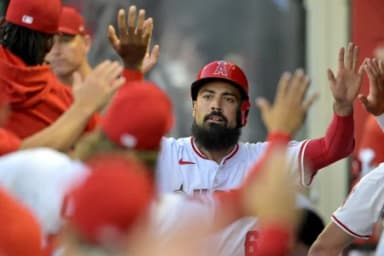
Anthony Santander played his first game in almost a year Wednesday, and the results were mixed.
It was his first appearance since Game 3 of last year's ALCS, serving as DH for Triple-A Buffalo in a 5-4 loss to the Charlotte Knights.
He went 0-for-4, but the box score doesn't tell the whole story of his return from surgery to repair a torn left labrum in his shoulder.
Facing Jonathan Cannon in the first inning, Santander fell behind 0-2 before grounding out to shortstop.
Cannon got him again in the third, freezing him on a 93.2 mph sinker for a strikeout looking.
His third at-bat told a better story. Leading off the sixth against Cannon, Santander drilled a changeup at 104.7 mph off the bat, only to see it fielded by second baseman Rikuu Nishida for a groundout.
His final at-bat ended in a five-pitch battle against Nick Altermatt, popping out to third on a 94.5 mph fastball.
Why the exit velocity matters more than the box score
That 104.7 mph groundout is the number worth remembering here, not the 0-for-4 line.
Santander signed a five-year, $92.5 million deal with Toronto back in January 2025, and his tenure so far has been defined almost entirely by injury.
He played just 54 games last season while dealing with shoulder inflammation, hitting .175 with six home runs and 18 RBIs in that stretch.
The plan now, according to Sportsnet's Arden Zwelling, has him getting into games as an outfielder before Toronto decides whether he's ready to join the 28-man roster.
Toronto's offense has needed exactly this kind of power all season, currently sitting with the third-fewest home runs and second-fewest runs scored in the majors.
Hard contact in a rehab opener, even without hits to show for it, is a real building block after this long away from competitive at-bats.
Whether that contact quality carries into his next few games will determine how quickly Toronto feels comfortable activating him for the stretch run.
Are you encouraged by Anthony Santander's exit velocity in his rehab debut despite the 0-for-4?
Voting closed