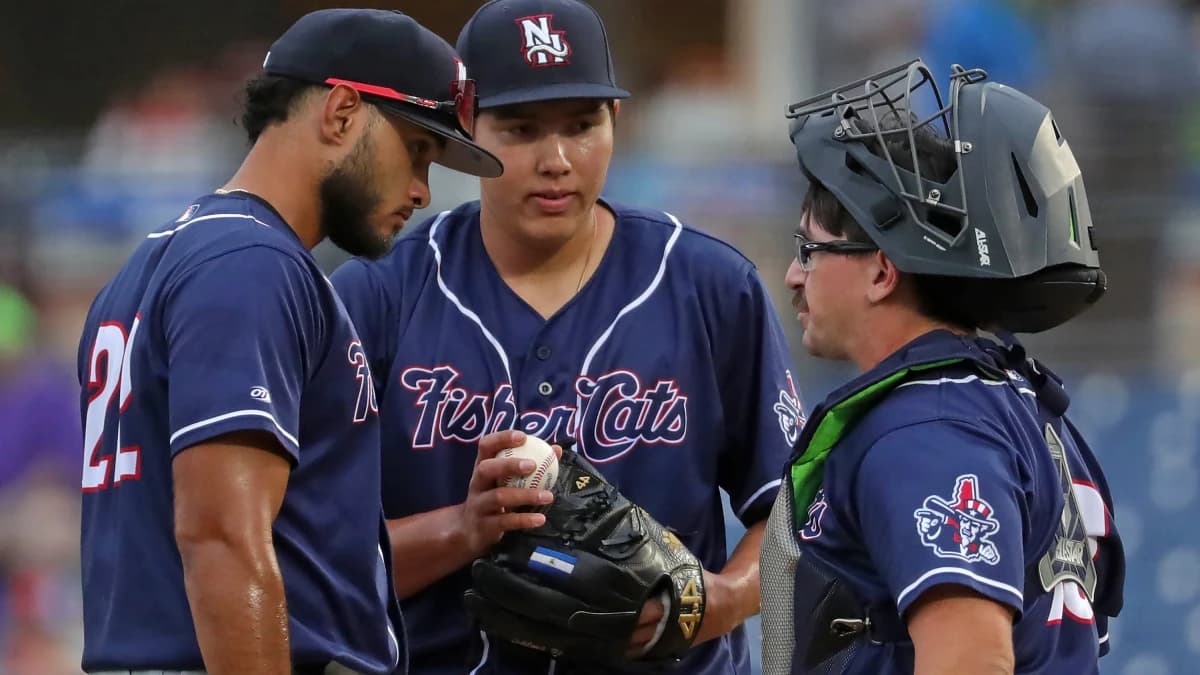

John Tamargo Jr. watched the Blue Jays' Double-A club do something Tuesday night that barely sounds real: score 8 runs before recording its first hit.
That is the kind of minor-league box score that makes people check it twice. Toronto's New Hampshire Fisher Cats hung a 10-run second inning on Portland and did most of the damage without putting a ball safely in play.
The inning started with chaos and never really stopped. New Hampshire took advantage of 8 walks, 4 wild pitches, 2 hit batters and a sacrifice fly before finally getting a 2-run single from Ismael Munguia.
That single was the first hit of the frame. By then, the Fisher Cats had already done enough damage to turn the game sideways.
The final score was 12-7, but the second inning is the part that will stick around the longest. It was a crooked number built almost entirely on pressure, patience and Portland losing the zone.
Hayden Mullins drew 5 walks in the game, while Jorge Juan added 3. For a Blue Jays development staff, that is not just weird baseball. It is a loud reminder that controlling the strike zone can break open an inning even when the hits are not coming.
Blue Jays prospect team erupts for bizarre 10-run inning
From a Blue Jays angle, this is why the inning matters beyond the novelty. New Hampshire did not luck into a cheap rally with bloops falling in. The Fisher Cats forced mistake after mistake until Portland completely lost its grip on the inning.
That kind of offensive pressure plays at any level. A club that keeps taking pitches, accepting free bases and moving runners without needing a barrage of hits is doing something development staffs love to see. That is an inference based on the inning's 8 walks, 4 wild pitches, 2 hit batters and sacrifice fly.
The historical angle makes it even better. According to the Elias Sports Bureau, no major-league team since 1961 has scored more than 4 runs in an inning before getting its first hit. New Hampshire got to 8.
That does not make it a major-league record, but it does show just how unusual this outburst was. Even in a sport built on strange nights, this was a rare one.
For Toronto, the clean takeaway is simple. The Blue Jays' Double-A affiliate gave the organization one of the oddest offensive innings of the year, and it came from discipline, traffic and relentless pressure rather than pure slugging. That is the sort of box score people remember.
Was this the strangest Blue Jays affiliate inning you have ever seen?
Voting closed