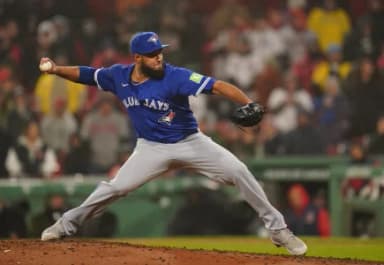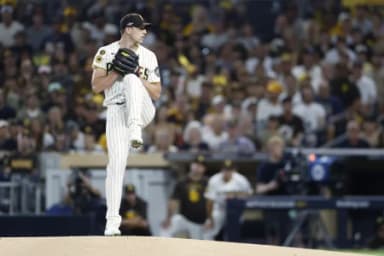

Michael King remains one of the Blue Jays' best rotation targets, but his sinking strikeout rate is the risk Toronto can't ignore.
His K/9 dropped from 9.33 in 2024 to 7.74 in 2026. That's the lowest mark of his career in any season with at least 50 innings.
He finished in the 38th percentile in strikeout rate and the 46th in whiff rate. Both are far from his 2024 levels.
His 4.33 xFIP was also his highest since 2021. It suggests he hasn't fully regained the form that made him one of the NL's best starters.
The sinker is the culprit. Its strikeout rate fell from 29.9% to 19.7%, and it allowed a .454 slugging percentage.
So why still sign him? Because he found other ways to win.
Michael King's changeup and sweeper kept him effective
His changeup posted a +12 Run Value, holding hitters to a .276 slugging percentage. The sweeper limited opponents to a .221 xBA.
He also excelled at avoiding hard contact. He ranked in the 89th percentile in hard-hit rate allowed.
Durability improved, too. After making only 15 starts in 2025, he went at least five innings in 28 of his 32 starts this year.
His home run rate dropped from 1.47 per nine to 0.97. That's a big swing in the right direction.
FanGraphs projects four years and $100 million. Among free agents, only Tarik Skubal posted a higher pitching Run Value.
Toronto should still make the offer, but four years is the limit. A pitcher losing strikeouts at 31 shouldn't get a fifth year, no matter how fierce the bidding gets.
He's like a hitter who's lost a little bat speed but learned to use the whole field. The approach works, as long as you don't pay for the old version.
Paired with Dylan Cease, he'd give the Jays a strong one-two punch. If the strikeouts don't come back, though, Ross Atkins will need Pete Walker's staff to keep the soft contact coming.
Should the Blue Jays give Michael King four years despite his falling strikeout rate?