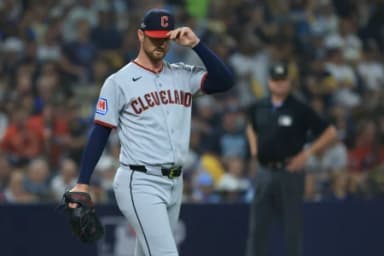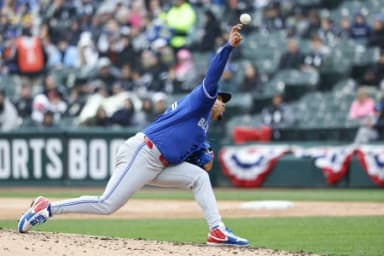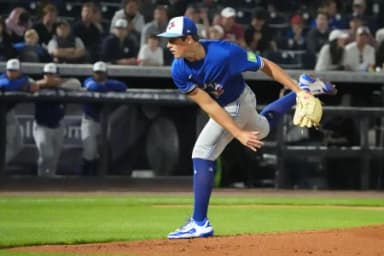

Foster Griffin could give the Blue Jays a lefty starter built to exploit an AL East weakness. The free agent is coming off a breakout return to MLB.
Several division rivals struggled against left-handers in 2026. The Rays posted a 90 wRC+ against lefties, second-worst in the American League.
The Red Sox were strong on the road against southpaws but managed just a 76 wRC+ against them at Fenway Park.
The Yankees' slugging percentage against lefties also dropped away from Yankee Stadium, from .458 at home to .387 on the road.
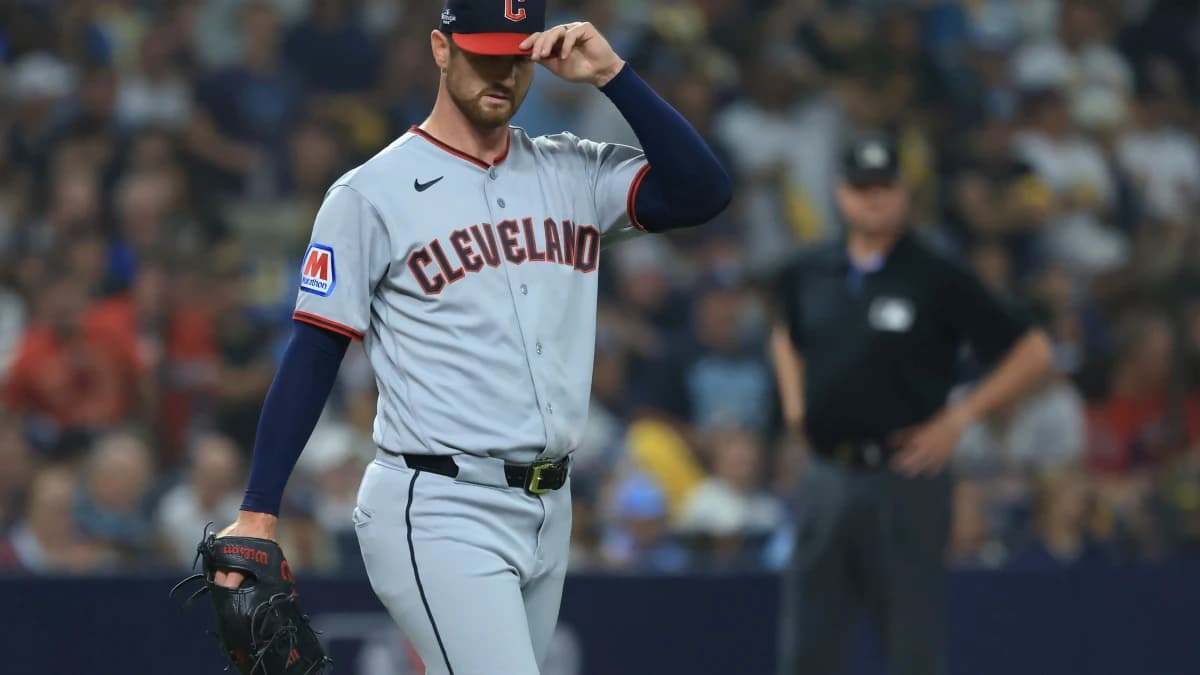
Griffin finished 15-6 with a 3.60 ERA between the Nationals and Guardians. It was his first MLB season after three years with the Yomiuri Giants, where he posted a 2.57 ERA.
How does he do it without velocity? Command and movement.
Foster Griffin's 89.8 m.p.h. fastball plays far above its speed
His fastball averaged under 90 m.p.h., but its +16 Run Value is the best among left-handed starters on the market.
He mixes seven pitches, and five of them generated whiff rates above 20%. Against lefties, he allowed just a .645 OPS.
He also didn't walk any of the last 55 left-handed hitters he faced. That's elite control.
Durability helped, too. He worked at least five innings in 27 of his 31 starts, behind a Nationals defence that ranked among the worst in baseball.
October didn't faze him. He struck out 15 and walked none over 10.1 postseason innings.
Griffin is a better fit than he looks on paper. Toronto's rotation is all right-handed, and a lefty who thrives against left-handed bats could swing key division series.
He's like a crafty chess player in a room full of speed-game specialists. He doesn't need to move fast when every piece is in the right place.
A two-year deal around $30 million or a one-year deal with an option could get it done. If Ross Atkins wants a lefty with upside, Griffin belongs alongside Trevor Rogers at the top of the list.
Should the Blue Jays sign Foster Griffin as their left-handed starter?