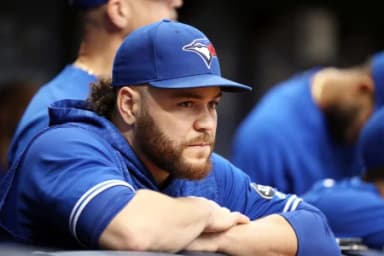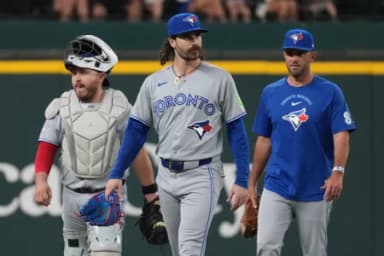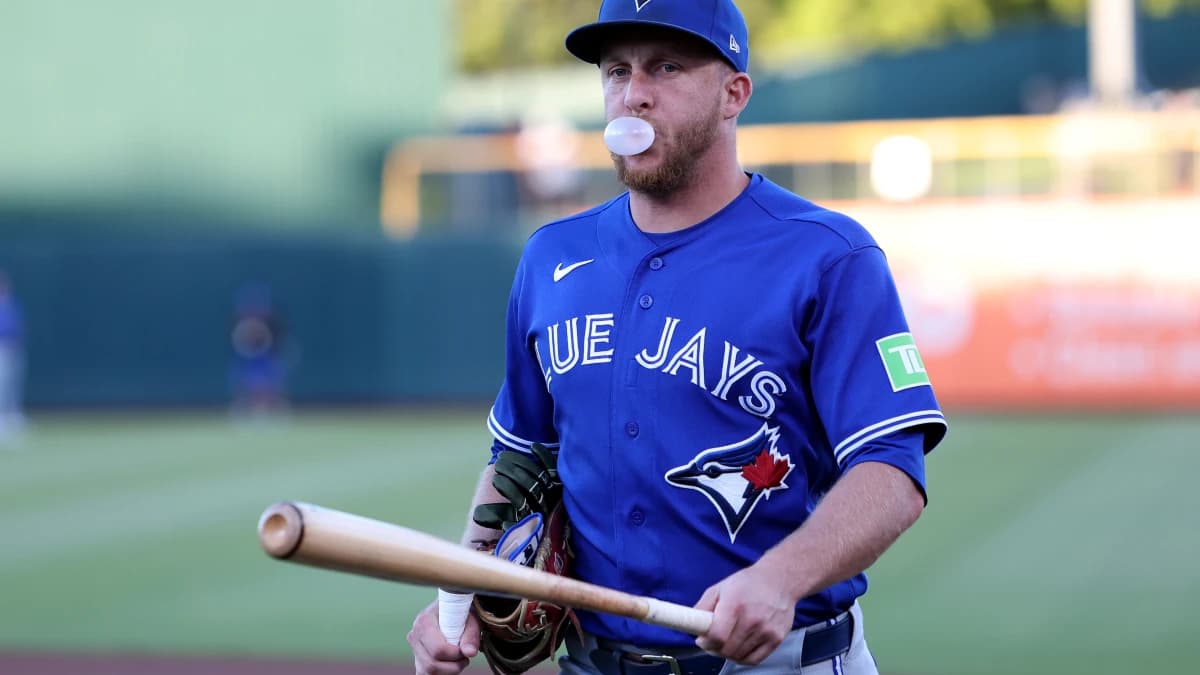

Myles Straw has a clear message for the Blue Jays as his contract decision looms.
Toronto enters an offseason filled with roster questions after a disappointing 2026 season, and Straw's situation is one of the clearer financial calculations the front office faces.
GM Ross Atkins should have real payroll flexibility to work with. Toronto carried roughly $275 million in payroll this year and currently has about $195 million committed for next season, per the Canadian Press.
That flexibility extends across several expiring deals, including free agents George Springer, Max Scherzer, Paul Sewald, and Shane Bieber.
Straw's situation is different. He has an $8 million club option for 2027, carrying a $1.75 million buyout, as part of the $25 million deal he originally signed with Cleveland in 2022.
Why the real cost is actually lower than it appears
There's an important wrinkle here. The Guardians agreed to cover the buyout amount as part of the trade that sent him to Toronto, whether the option gets exercised or not.
"So it's a $6.25-million call, one the outfielder hopes keeps him in Toronto," Shi Davidi reported for Sportsnet.
Straw didn't hide his hope to stay. "I'd love to be back," he said. "All of us that are going to be leaving feel the same way. But I get it, it's a business, I've been through a lot in this game. They're going to do whatever they've got to do, which I understand. We'll see."
The decision likely depends heavily on how Toronto views its outfield picture going forward. Brett Bateman has emerged as a real everyday piece, Springer appears to be on his way out, and Anthony Santander remains frequently injured.
That leaves Straw waiting on an organization he clearly wants to stay with.
The real question for Toronto isn't the full $8 million figure, it's whether his defensive value and clubhouse familiarity justify a $6.25 million net cost when the front office has other places it could redirect those resources this offseason.
Given the reduced financial exposure thanks to Cleveland's contribution, this decision looks considerably easier to justify than a full $8 million commitment would.
Should the Blue Jays exercise Myles Straw's option given the reduced net cost?